Transition 113 by IU Press Journals
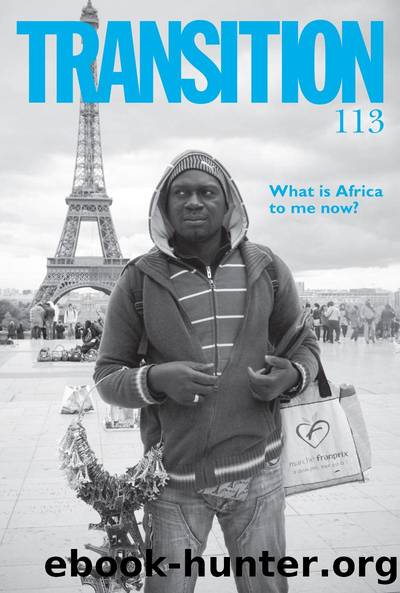
Author:IU Press Journals [Journals, IU Press]
Language: eng
Format: epub
Tags: Literary Collections, African, Art, Popular Culture
ISBN: 9780253018601
Google: i57CBwAAQBAJ
Publisher: Indiana University Press
Published: 2015-02-20T22:24:51+00:00
Tournay-Theodotou: In Red Dust Road you mention several black writers that changed your life when you read them as a young person: James Baldwin, Frantz Fanon, Richard Wright, Ralph Ellison and others. How important have these literary predecessors been in your writing? Which other writers have influenced you? What are your literary affinitiesâAfrican American, Black British, African, or others? Does anybody stand out?
Chinua Achebe and Wole Soyinka were very important writers for me to come across. They were my early influences. But I also steeped myself in Scottish poetry.
Kay: I first started reading African American writers when I was in my twenties so they were my first passionate influence because before then I hadnât come across any black writers at all. Once I did start to discover Toni Morrison, Alice Walker, Nikki Giovanni, Audre Lorde, I just tried to get my hands on everything that I could find. I found books that had been published earlier by Ann Petry, James Baldwin, Richard Wright, Ralph Ellison. Then I found African fiction. Chinua Achebe and Wole Soyinka were very important writers for me to come across. They were my early influences. But I also steeped myself in Scottish poetry. Robert Burns, Hugh MacDiarmid, Tom Leonard, and Liz Lochhead were all early influences in Scottish poetry. I also found the nineteenth-century novel fascinating. I loved the work of George Eliot in particular, but I liked the Brontës hugely as well. I really liked the Russian writers so I read a lot of Chekhov and Tolstoy. I liked many of the Latin American writers. I liked the Chilean poet Pablo Neruda. Then I started reading a lot of Canadian writers, Alice Munro, Barbara Gowdy. The thing is to read as widely as possible and to see that whatever you think, someone else has been on that road before. But you also need to try and find a way to carve out your own territory, to be a pioneer. I also did a whole course on the Indian novel and read a lot of books either by Indian writers such as Anita Desai, Mulk Raj Anand, Ruth Prawer Jhabvala or Anglo-Indian writers, like E. M. Forsterâs Passage to India. I find books that travel and make me travel with them exciting. I think that reading changes your identity; youâre drawn to things that are currently chiming with whatever you are actually going through. At the moment Iâm returning to certain books. Iâve been re-reading Zora Neale Hurstonâs Their Eyes Were Watching God, Sylvia Plathâs The Bell Jar, Ralph Ellisonâs Invisible Man and Lewis Grassic Gibbonâs Sunset Song. They all seem to be guiding me with the novel Iâm working on now: Bystander. With every project there are guiding books which haunt the text that you are writing. So when I was working on Red Dust Road the two books that I read over and over again were Blake Morrisonâs And When Did You Last See Your Father? and Diana Athillâs Somewhere Towards the End. Those two memoirs really excited me because of their episodic structure.
Download
This site does not store any files on its server. We only index and link to content provided by other sites. Please contact the content providers to delete copyright contents if any and email us, we'll remove relevant links or contents immediately.
In Control (The City Series) by Crystal Serowka(36353)
The Wolf Sea (The Oathsworn Series, Book 2) by Low Robert(35372)
We Ride Upon Sticks by Quan Barry(34723)
Crowbone (The Oathsworn Series, Book 5) by Low Robert(33766)
The Book of Dreams (Saxon Series) by Severin Tim(33527)
The Daughters of Foxcote Manor by Eve Chase(23771)
Trainspotting by Irvine Welsh(21965)
Call Me by Your Name by André Aciman(20711)
The Secret History by Donna Tartt(19464)
Shot Through The Heart (Supernature Book 1) by Edwin James(19043)
All the Missing Girls by Megan Miranda(16684)
American King (New Camelot #3) by Sierra Simone(16580)
The Girl from the Opera House by Nancy Carson(15890)
Pimp by Iceberg Slim(14785)
Sad Girls by Lang Leav(14632)
The Betrayed by David Hosp(12980)
The Betrayed by Graham Heather(12956)
4 3 2 1: A Novel by Paul Auster(12609)
Still Me by Jojo Moyes(11466)
